

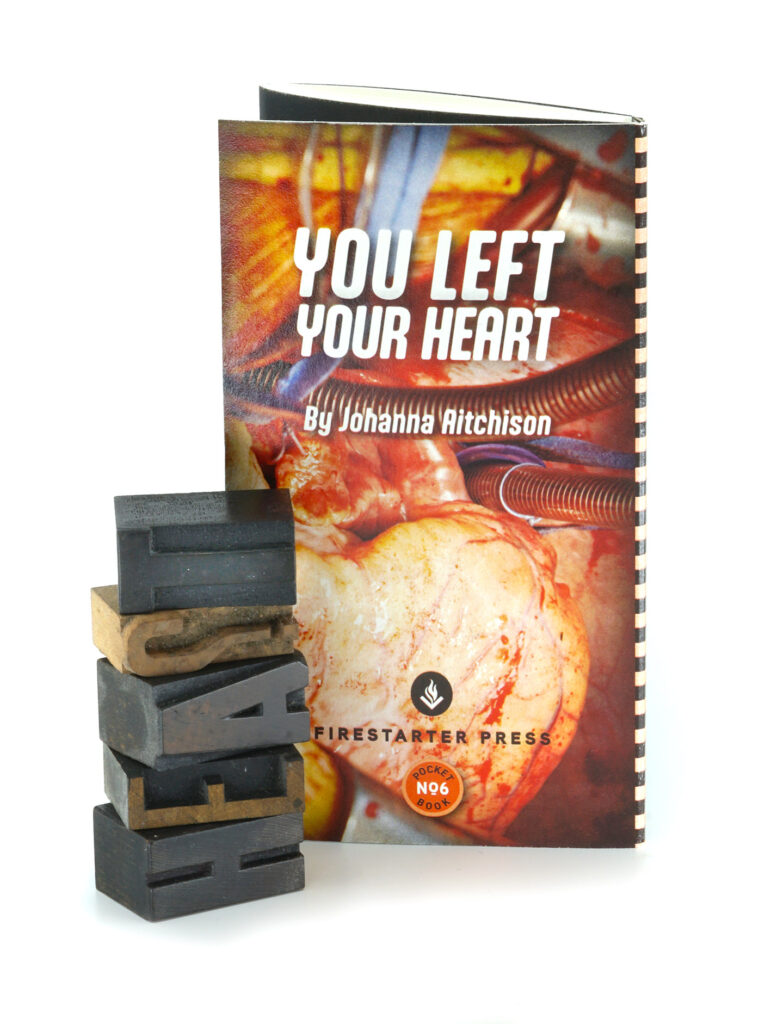
Manawatū poet Tim Upperton reviews Johanna Aitchison’s You Left Your Heart. This review first appeared in the Winter 2026 edition of A Fine Line – The Magazine of the Te Rōpū Toikupu O Aotearoa New Zealand Poetry Society.
The seventeen prose poems that comprise this collection are located in a world made familiar and strange, and are various in their geography (ranging from the Desert Road volcanic plateau to the American Midwest to Pakistan), their subject matter, and their personae.
The ‘I’ moves from one poem to the next, will not stay still, will not even stay the same speaker. But throughout the collection runs a narrative elusiveness coupled with surreal imagery – something we don’t see much of in Aotearoa New Zealand poetry but will be familiar to readers of, say, James Tate or Charles Simic, and the poets grouped by American poet and critic Stephanie Burt under the label of ‘elliptical poetry’.
The stand-out poem in this vein is “Buffalo”, which begins with a casual conversation between the speaker and her friend ‘outside the Cook Street Dairy’ about milk, and then shifts to the responsibilities of owning a buffalo in Pakistan. Soon the speaker is imagining caring for a buffalo of her own, and then a herd, and what such a life would offer her:
Your nights will ripen into village parties. “These people,” you cry, as you twirl and twirl, “Where were you all before?” You can see the gathered backs of the herd tearing up the lawn, they are sharing out the winds of the savannah. With their milk you toast the moon; to the sky whose rhythm you thought you’d lost forever. To the drum, which has taken on new hooves and got to beating. To the buffaloes: you appoint them Chief Shredders of the torn grass; you appoint them High Forest Eaters. Let us stand, let us stomp, let us split open the skull’s house and roam again.
(“Buffalo”)
It’s a freewheeling poem that surprises at every turn, and the language evolves from the poem’s homely beginning to the elevated diction of an ode, a spell, even a prayer (with a nod, in that concluding phrase, to that classic American folk song, “Home on the Range”).47 © New Zealand Poetry Society / Winter 2026 / Editor: Cadence Chung / editor@poetrysociety.org.nz
The poems also hark back to the so-called Confessional poets of the 1950s and ’60s, and their experiments with the ‘I’ (these experiments make ‘Confessional’ a misleading term). In another poem, “I am Living in a Hole with John Berryman”, an Aitchison persona participates in a dialogue with a famous Berryman persona – ‘Henry’ from Berryman’s Dream Songs: “‘Are you really Henry?” I ask Berryman. “You know the answer to that,” he says, “not the poet, not me.’” (“I am Living in a Hole with John Berryman”).
The status of the ‘I’ is uncertain, provisional, in ways that serve the poems but that also suggest questions about our own identities – the stability of those identities, whether they are singular or plural, immutable and essential or flimsy, make-do constructions. In the first poem of the collection, “Miss Dust at the Scanner”, the speaker is standing at the airport scanner when officials demand that she
remove her shoes. But that is not enough: ‘Scan Officers ask her to remove her belt.’ Still not enough: ‘The officers are afraid they’ll have to examine her peepers as well. Miss Dust scrapes out her eyes and drops them onto the tray. The Scan Officers are really sorry, but they’ll also need to see her teeth.’ (“Miss Dust at the Scanner”). At a surface level this poem concerns the dehumanising, invasive demands at immigration checkpoints; at a deeper level it asks where the self resides. Such checkpoints exist to confirm identity status – but what would confirm that? How many layers does a self have?
The poems tackle these philosophically and psychologically fraught questions with a lightness of touch that is engaging and funny. I admire the way they evoke the everyday negotiations a restless intelligence must make with a world inimical to it. This small book, which fits easily in the palm of your hand, expands upon reading.
Read more at A Fine Line
Buy a copy of You Left Your Heart